
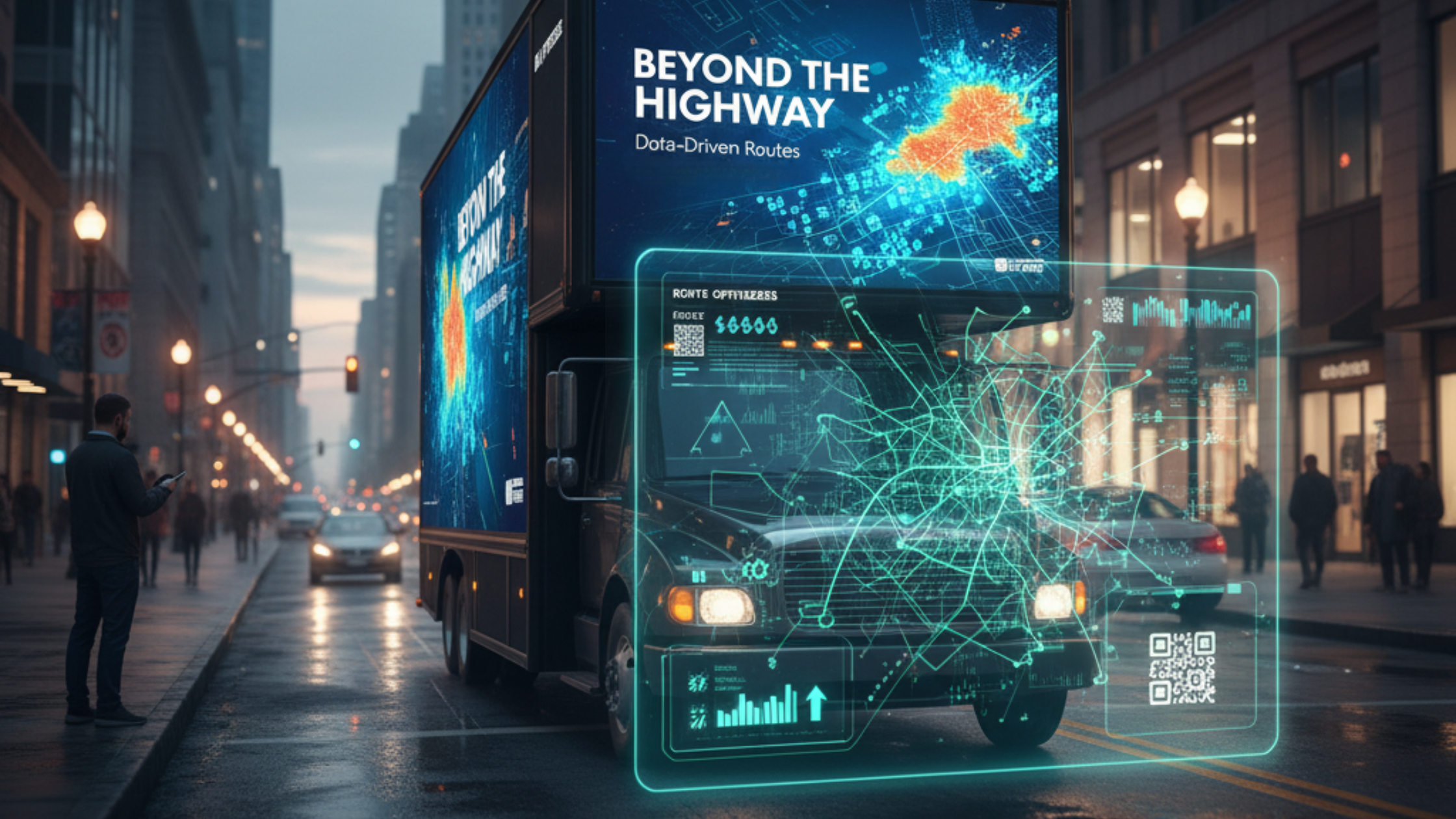
You have a stunning creative design and a clear, compelling message. Your mobile billboard is ready to roll. But here’s the crucial question: Where should it go?
If you’re relying on the outdated tactic of just “driving around” to hit random, high-traffic areas, you’re missing out on serious ROI. A mobile billboard is only as effective as the path it travels, and without a strategic plan, you’re essentially leaving money—and valuable impressions—on the road.
The key to running a high-impact Out-of-Home (OOH) campaign is implementing a strategic, data-driven route plan. This is the ultimate guide to mastering your mobile billboard route strategy, breaking down the five critical secrets we use to ensure your campaign is hitting the right eyes at the right time.
1. The Audience Density Heatmap (Targeting Demographics)
The flaw of volume is simple: simply targeting high-traffic areas isn’t enough; you must target relevant traffic. Driving past a million people who will never buy your product is less valuable than driving past 10,000 highly qualified leads.
We start by analyzing your ideal customer profile using location-based data. This includes age, income, interests, and purchase history, combined with insights from tools like census data or geo-location reports. This analysis allows us to create an “audience density heatmap” of your city.
For example, if your target is affluent young professionals, the route must focus on business districts during morning and evening rush hours, plus areas around high-end gyms or popular entertainment venues after work. We bypass the residential suburbs until the weekend, focusing the campaign exactly where your customers are likely to be.
2. Mastering the Dwell Time (Traffic Flow vs. Congestion)
In mobile OOH, time is everything. A stationary ad gets significantly more viewing time than one zipping by. This is why the best routes are not high-speed, open highways.
The most effective routes are those with predictable slowdowns. We analyze traffic flow data to pinpoint locations where vehicles and pedestrians are forced into a “captive audience” moment:
- Long, timed stoplights at major intersections.
- Entry and exit points of congested business centers.
- Slow-moving downtown construction zones.
- Toll plazas or ferry waiting lines.
These are the areas that allow your message to be fully absorbed, making your mobile billboard route strategy exponentially more impactful than highway cruising.
3. The Competitor Containment Loop (Strategic Counter-Targeting)
One of the greatest advantages of a mobile billboard is its flexibility, which allows you to directly counteract the static nature of your competitors’ advertising.
The Strategy: Use your mobility to plant your message directly in front of the people already seeing your competitor’s ads.
If a competitor has a major, costly static billboard near a shopping center, we will route your mobile billboard to circle that area or wait strategically at key entry/exit points for a 30-minute rotation. Your ad acts as a “second touch,” reinforcing your brand or offering a direct counter-message right after they view the competing ad. This is especially powerful for store openings, product launches, or special promotions.
4. The Event/Geo-Fence Blitz (Timing and Location Integration)
Timing is paramount. Major public events—concerts, sporting games, conventions, or farmers’ markets—create massive, temporary, and highly specific target audiences.
The Tactic: Our route planning integrates with the local calendar. We can schedule a campaign to run intensely just as a major event is letting out, allowing your billboard to hit thousands of focused people in a highly localized area in a matter of minutes. For a financial services client, routing around a major business conference is non-negotiable.
Advanced Tip: For maximum effect, we often recommend pairing the OOH route with digital geo-fencing to hit the same crowd on their mobile devices, cementing the message through cross-platform exposure.
5. The A/B Test and Optimize Protocol
Unlike a static billboard that is fixed for months, the flexibility of our service means we can—and should—change the route based on performance.
The Protocol: We often run the campaign on two slightly different route models during the first week. By tracking GPS logs alongside conversion metrics (when a unique URL or QR code is used), we can see which model delivers higher engagement or reach. The underperforming route is then adjusted or replaced to maximize the impact of the remaining schedule. This dynamic approach ensures your investment is continuously optimized.
Ready to Drive Precision, Not Randomness?
A great mobile billboard campaign is about precision, not just volume. By using a data-driven mobile billboard route strategy, you move beyond random driving to targeted marketing that delivers measurable results.
Ready to stop guessing and start targeting? Contact us today to map out your perfect, high-ROI mobile billboard campaign.
